

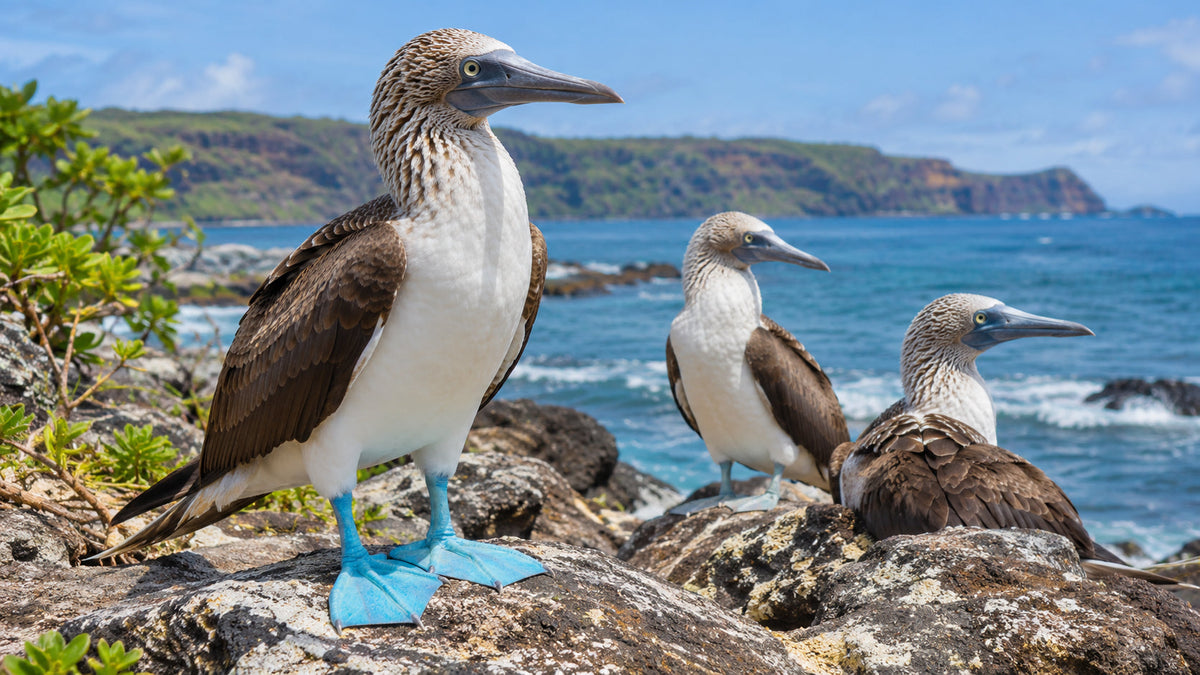
Boobies: Meet the Fascinating Seabirds with the Unforgettable Name
Few seabirds attract quite as much attention as the booby. With their unusual name, spectacular diving abilities and, in some species, brilliantly coloured feet, these remarkable ocean birds are among the most entertaining and fascinating creatures found along tropical coastlines. From their elaborate courtship dances to their incredible hunting skills, boobies have developed a range of extraordinary adaptations that make them perfectly suited to life at sea.
What Exactly Is a Booby?
Boobies are large seabirds belonging to the genus 'Sula', part of the Sulidae family, which also includes gannets. They are found mainly in tropical and subtropical oceans, where they spend much of their lives flying over open water, hunting fish and returning to remote islands to breed.
There are six living species of booby, each with its own distinctive appearance and behaviour. Perhaps the most famous is the Blue-footed Booby, instantly recognisable by its bright blue feet and comical mating dance.
Despite their somewhat clumsy appearance when walking on land, boobies are remarkably graceful and efficient in the air. Their streamlined bodies, long pointed wings and powerful flight muscles allow them to travel considerable distances in search of food.
And what about that unusual name? The word 'booby' is widely believed to originate from the Spanish word 'bobo', meaning foolish or silly. Early sailors apparently considered these birds rather stupid because they showed little fear of humans and could often be approached or captured with surprising ease. In reality, their trusting nature was simply the result of evolving in environments where large land predators were relatively uncommon.
Meet the Six Species of Booby
Blue-footed Booby (Sula nebouxii)
Arguably the most recognisable species, the Blue-footed Booby is famous for its extraordinary bright blue feet. Found along the Pacific coast of the Americas, particularly around the Galápagos Islands, these birds use their colourful feet to attract potential mates. The more vibrant the blue, the more attractive the bird may appear to a partner.
Red-footed Booby (Sula sula)
The Red-footed Booby is the smallest of the six species and is instantly recognisable by its vivid red feet. Unlike many other boobies, it frequently nests in trees and shrubs rather than directly on the ground. Interestingly, its plumage varies considerably, ranging from predominantly white to rich brown.

Brown Booby (Sula leucogaster)
With chocolate-brown upperparts contrasting against a bright white belly, the Brown Booby is a familiar sight across warm tropical oceans. These strong fliers are often seen hunting close to shore and sometimes take advantage of fish driven towards the surface by larger marine predators.
Masked Booby (Sula dactylatra)
The Masked Booby is the largest booby species. Its predominantly white plumage, black wing tips and distinctive dark facial mask give it an elegant appearance. It usually nests on open, relatively flat tropical islands.
Nazca Booby (Sula granti)
Found mainly in the eastern Pacific, particularly the Galápagos Islands, the Nazca Booby closely resembles the Masked Booby but has distinctive features, including an orange to pinkish bill. It is especially well known for its unusual breeding behaviour.
Peruvian Booby (Sula variegata)
The Peruvian Booby inhabits the Pacific coastline of South America, particularly Peru and Chile. It is closely associated with the nutrient-rich Humboldt Current and feeds extensively on schooling fish such as anchovies. Large breeding colonies can gather on offshore islands.

Masters of the Ocean Dive
One of the most impressive things about boobies is the way they catch their food.
These seabirds are specialised plunge divers, capable of spotting fish from the air before folding their wings backwards and diving headfirst into the ocean. Their streamlined bodies allow them to penetrate the water with remarkable speed and precision.
Some species dive from considerable heights, entering the water at high speed to capture fish and squid beneath the surface.
Their anatomy is specially adapted to withstand the impact. Air sacs within the body help cushion the force of entering the water, while their nostrils are externally closed, preventing water from rushing into their respiratory system during a dive.
Boobies are particularly fond of small schooling fish, including sardines, anchovies and flying fish. Watching a group of them hunting is an extraordinary sight, with birds repeatedly plunging into the sea as they pursue moving shoals.
The Famous Blue-footed Booby Dance
Perhaps the most entertaining aspect of booby behaviour is the courtship display of the Blue-footed Booby.
When a male wishes to impress a female, he performs an elaborate dance in which he lifts one bright blue foot high into the air, places it carefully back on the ground and then repeats the movement with the other foot.
The result looks almost like a slow, exaggerated marching routine.
This display is far more than a comical performance. Foot colour provides information about the bird's condition, with brighter feet often indicating a healthier individual. Females may therefore use these displays to assess potential mates.
The courtship ritual also includes wing spreading, bill pointing, whistling and the presentation of nesting material.
For anyone lucky enough to witness it, the display is one of nature's most memorable mating rituals.

Life on Remote Tropical Islands
Boobies typically breed in colonies on islands, coastal cliffs and other relatively isolated locations.
Depending on the species, nests may be built directly on the ground, among rocks or in trees and shrubs.
Most boobies lay between one and three eggs, although the number varies by species. Both parents generally take turns incubating the eggs and feeding their chicks.
Unlike many birds, boobies do not have a conventional brood patch. Instead, they use their highly vascularised feet to help transfer warmth to their eggs.
Life in a booby colony can be surprisingly competitive. In some species, the first chick to hatch may dominate its younger sibling, particularly when food is scarce. The Nazca Booby is especially well known for sibling aggression, with younger chicks frequently failing to survive.
Although this behaviour may appear harsh, it reflects the difficulties of raising young in environments where food availability can change dramatically.
Are Boobies Endangered?
Not all booby species face the same conservation challenges, but many populations are vulnerable to changes in their marine environment.
Overfishing can reduce the availability of the small fish they depend upon, while marine pollution, plastic waste and accidental capture in fishing gear can also present serious threats.
Changes in ocean temperatures and currents can disrupt marine food webs, affecting breeding success and chick survival.
Introduced predators, including rats and feral cats, have also caused problems at some seabird nesting colonies.
Protecting breeding islands, maintaining healthy fish populations and reducing marine pollution are all important measures for safeguarding these remarkable birds.
Why Boobies Deserve Our Attention
Their name might make people smile, but boobies are extraordinary seabirds that deserve genuine admiration.
From the brilliantly coloured feet of the Blue-footed Booby to the spectacular plunge-diving abilities shared across the group, these birds demonstrate just how remarkable adaptation to life at sea can be.
They are also important indicators of marine ecosystem health. Changes in their populations, feeding behaviour and breeding success can provide valuable clues about conditions in the surrounding ocean.
Whether you're interested in marine biology, wildlife photography or simply discovering some of the world's more unusual animals, boobies offer a fascinating glimpse into the remarkable diversity of ocean life.
And while their name might be a little unfortunate, there's certainly nothing foolish about these magnificent seabirds.
To learn more about sealife Around our Shores in Britain please click here.
Photo credit(s): Red footed Booby, Peruvian Booby - Shutterstock; Title - ChatGPT.


